ANTON J. LAUBY · INVENTOR & MANUFACTURER
Innovation in wood,
wire, and water.
A Wisconsin lure-making pioneer whose work connected inventive bait designs with the tools and techniques needed to produce them.

The inventor behind
the Wonder Spoon.
Anton J. Lauby brought the practical skills of a carpenter and mechanic to fishing-tackle design. The 1999 account by Charles and Annette Sanders describes a workshop where he tested lures in tanks and developed equipment to shape their wooden bodies.
His work addressed the action of a lure, the placement of its hooks, and the difficulty of making the same form repeatedly. Patents, catalogs, and published workshop accounts reveal the breadth of that contribution.
Sanders & Sanders, December 1999, p. 24; Slusar, pp. 365–374. The portrait is also reproduced and identified in both publications.
THE ENGINEERING
Three problems. A sustained inventive response.
A spoon that could float
Lauby’s 1935 patent describes a buoyant spoon body that turns on a supporting rod. An angled, beveled edge directs water against its concave face to produce rotation and irregular movement. It puts the body’s shape and buoyancy at the center of the design. US 1,996,477.
The later commercial Wonder Spoon was promoted for a tail-driven wobble and a direct wire connection between line and hook. Its cataloged construction should be studied alongside the patent: the familiar production spoon is not identical to the rotating design in the patent drawing. 1939 catalog, reproduced in Slusar, pp. 369–371; Sanders & Sanders, December 1999, p. 26.
Hooks suited to the way a bait moves
Two patents granted in 1940 explore different arrangements. US 2,187,475 describes a buoyant plug with an embedded wire and hook attachments. US 2,215,908 describes a hook whose point rests within a slot in the body, protecting it during travel through vegetation. These documents show continued development beyond the first spoon. January patent · September patent.
Machinery for making the design
The workshop account describes cedar stock turned into an oval form, split into paired blanks, shaped with a purpose-built grooving tool, and smoothed in a rotating drum before finishing. Sanders credits Anton with designing the tools and having them built locally. Sanders & Sanders, December 1999, p. 26.
His 1944 lathe-chuck patent supplies a separate engineering record: an adjustable arrangement for turning small bodies and boring them centrally, including artificial bait plugs. US 2,341,926. The patent does not establish that every earlier workshop tool used this later design.
DESIGN, PRODUCTION & CONTINUITY
An inventor’s working life.
A documented starting point
The artificial-fish-lure application was filed September 15, 1933, and granted April 2, 1935. It anchors the patent chronology. Reports of earlier experimentation come from later recollections.
From workshop to organized production
A newspaper announcement dated August 3 names Anton as the inventor responsible for production. It sets out a target of 500 baits a day, not a verified output figure. The company displayed its tackle at the Chicago exposition that August. Sanders and Slusar place incorporation in November.
Sanders & Sanders, December 1999; 1938 exhibition photograph
An extensive commercial range
The catalog shows casting and fly-rod Wonder Spoons, Weedless Wonder Spoons, Surface Lures, Special Minnows, rods and flies. Sixteen patterns were offered for the spoon and surface-lure lines. A February 25 newspaper extract reports 49 employees at the Marshfield operation.
1939 catalog, reproduced in Slusar, pp. 369–371; Sanders & Sanders, December 1999, pp. 24, 26
The designs continue under Bates
After financial difficulties, the designs passed to Albert J. Bates. Anton continued supervising production. The Bates catalog carried forward the Wonder Spoon, weedless spoon, surface lure and minnow under new names. Published accounts disagree on the exact timing of the move to La Crosse.
An invention for manufacture
The lathe-chuck patent was granted February 15, 1944. It documents Anton’s attention to manufacturing technique as well as the finished bait.
Later manufacture and another patent
Slusar reports that Anton and Leonard Hahn made wooden minnows for Paul Bunyan in Milwaukee in late 1945 and 1946. Separately, a collapsible-bait patent with opposed hooks and a spring was granted January 8, 1946.
Work for another Wisconsin maker
Slusar records Bud and Roz’s recollection of turning Marathon Musky Munk blanks on a special lathe in Cedarburg. That account extends Anton’s manufacturing story beyond the company that originally bore his name.
Craftsmanship behind the production line
The published accounts also identify people who worked on the lures. TilLee described using fabric and a comb as masks for scale and barred paint patterns. Josephine worked at the Bates facility; Leonard Hahn later manufactured minnows with Anton. These specific contributions help explain how the designs were finished and produced. Slusar, pp. 366, 368, 373.
Slusar’s October 2004 interviews with TilLee, Roman (Bud), and Roz preserve eyewitness recollections of this work. Their testimony is cited as testimony, alongside the patents, advertisements, and catalog reproductions.
Why Anton’s work matters
Lauby’s place in early tackle history rests on more than a recognizable painted spoon. His record spans buoyant lure bodies, hook mechanisms, specialized manufacturing equipment, and designs marketed beyond the original Marshfield business. Studying those connections gives a fuller picture of the inventor and his contribution to Wisconsin lure making.
Examine the surviving lures and recordsFrom the printed record
From Lauby’s range to Bates advertising
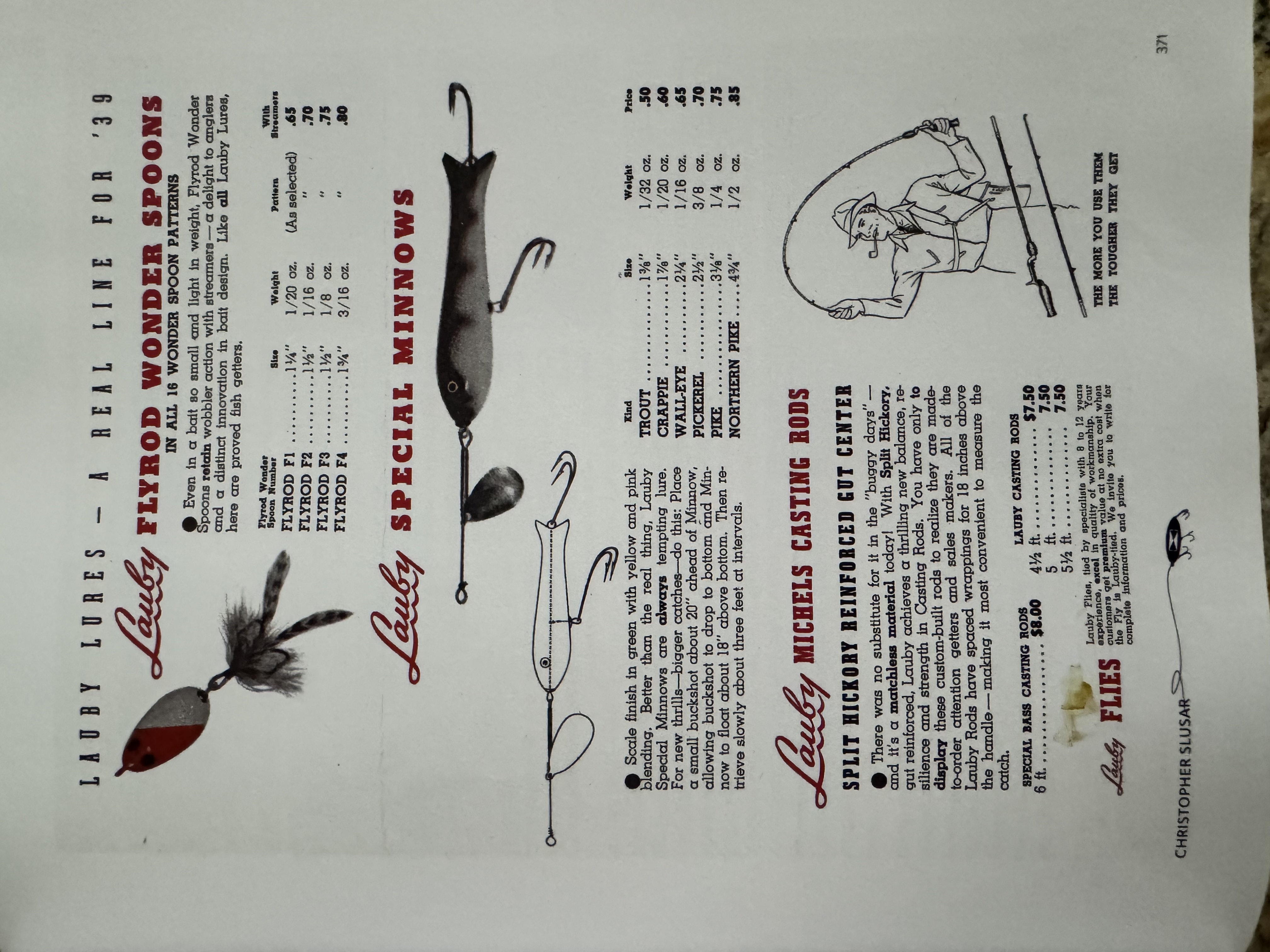
A broader range of baits
The complete 1939 catalog plate for Flyrod Wonder Spoons, Special Minnows, Michels casting rods and flies. Reproduced in Christopher Slusar’s history, p. 371.
Source detailsSelect image to enlarge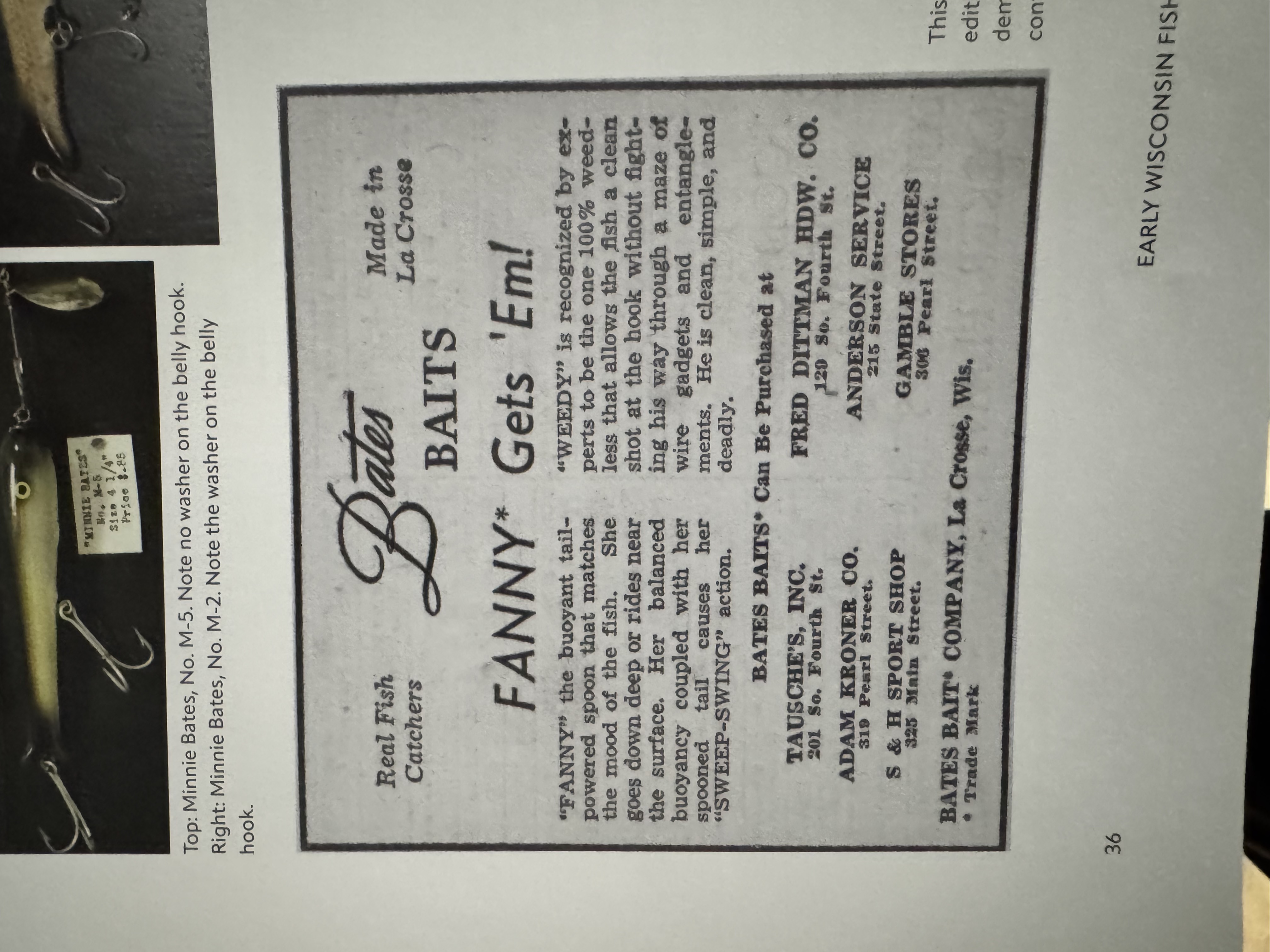
The designs reach a new market
Bates advertising for Fanny and Weedy, identified by Slusar as a La Crosse Tribune advertisement of May 14, 1942. Reproduced on p. 36; see the source notes for the Lauby–Bates manufacturing history.
Source detailsSelect image to enlarge