RESEARCH & ORIGINAL RECORDS
The evidence behind
the inventions.
Patents, period advertising, catalog reproductions, and published histories connect Anton’s designs to the lures and the business.
From the printed record
Catalogs, advertising & lure photographs.
Selected images from the supplied publication photographs. Catalog pages and ephemera are shown as reproduced in later histories; captions identify that source chain. Each image is framed around a complete catalog plate, advertisement, instruction sheet or group of lure photographs.
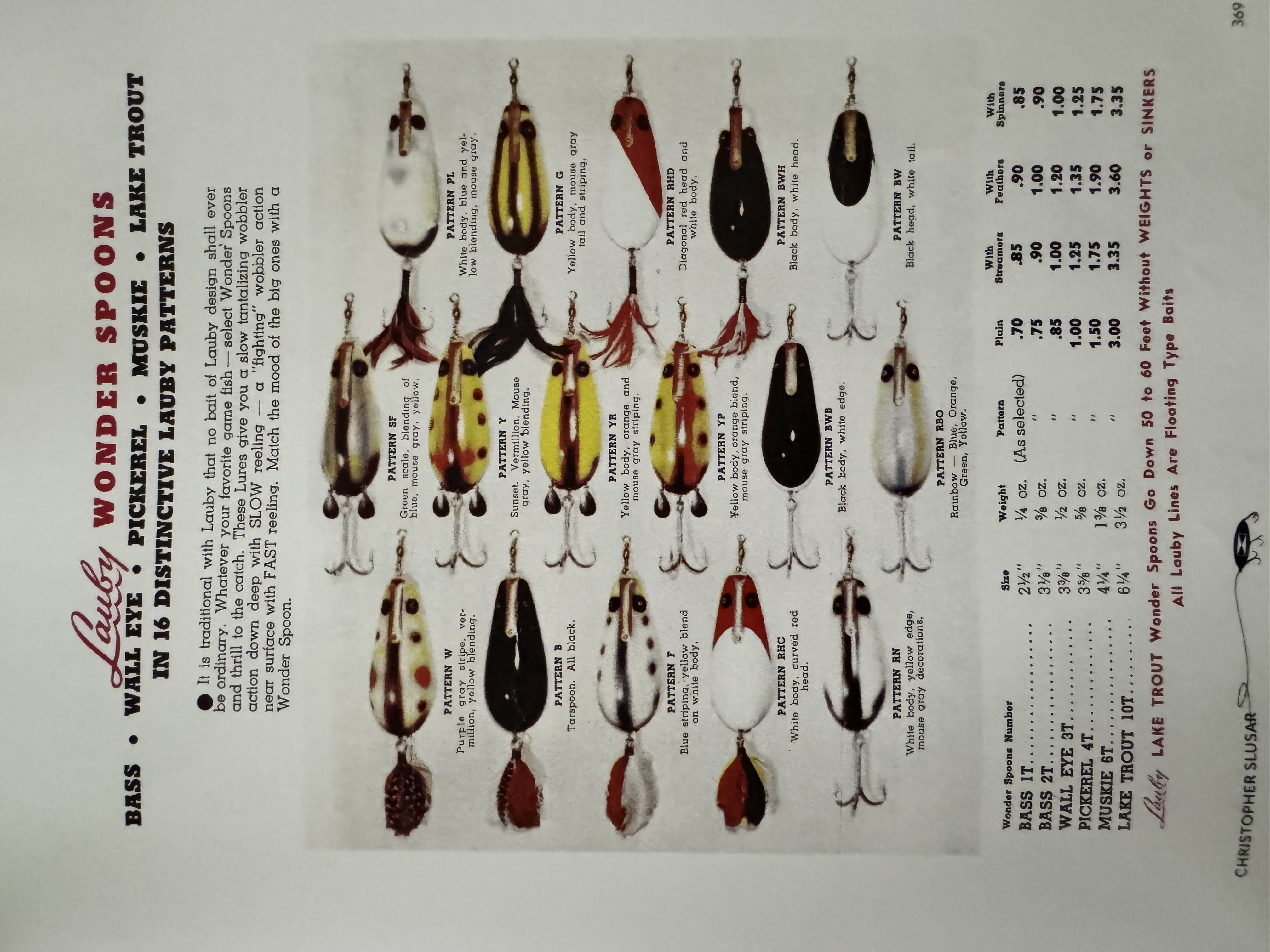
Sixteen patterns, one Wonder Spoon
The 1939 catalog’s Wonder Spoon color chart, with advertised casting sizes and prices. Reproduced in Christopher Slusar’s history, p. 369.
Source detailsSelect image to enlarge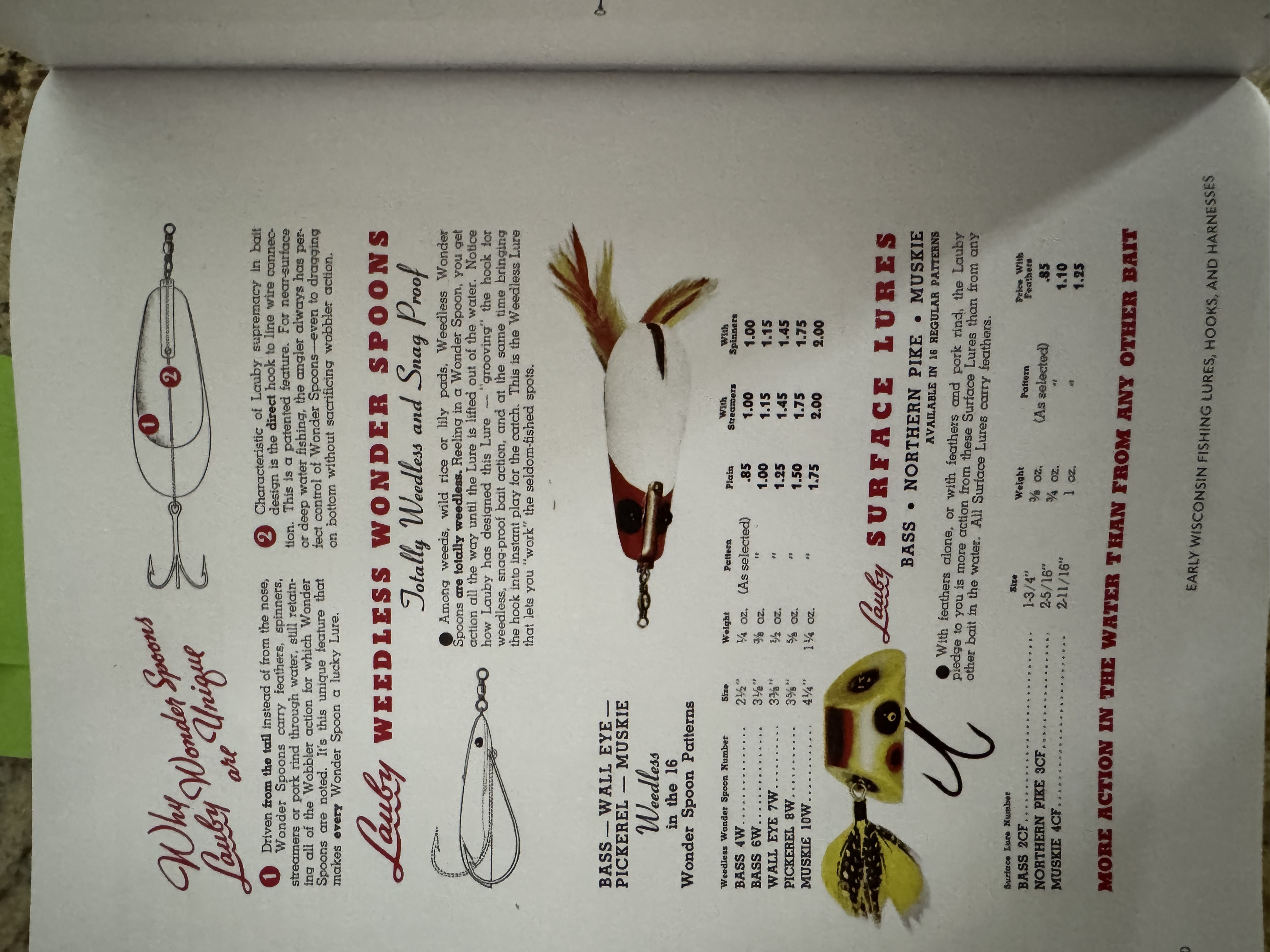
Explaining the action
The complete 1939 catalog plate explaining Wonder Spoon action and presenting Weedless Wonder Spoons and Surface Lures, with their advertised sizes and prices. Reproduced in Christopher Slusar’s history, p. 370.
Source detailsSelect image to enlarge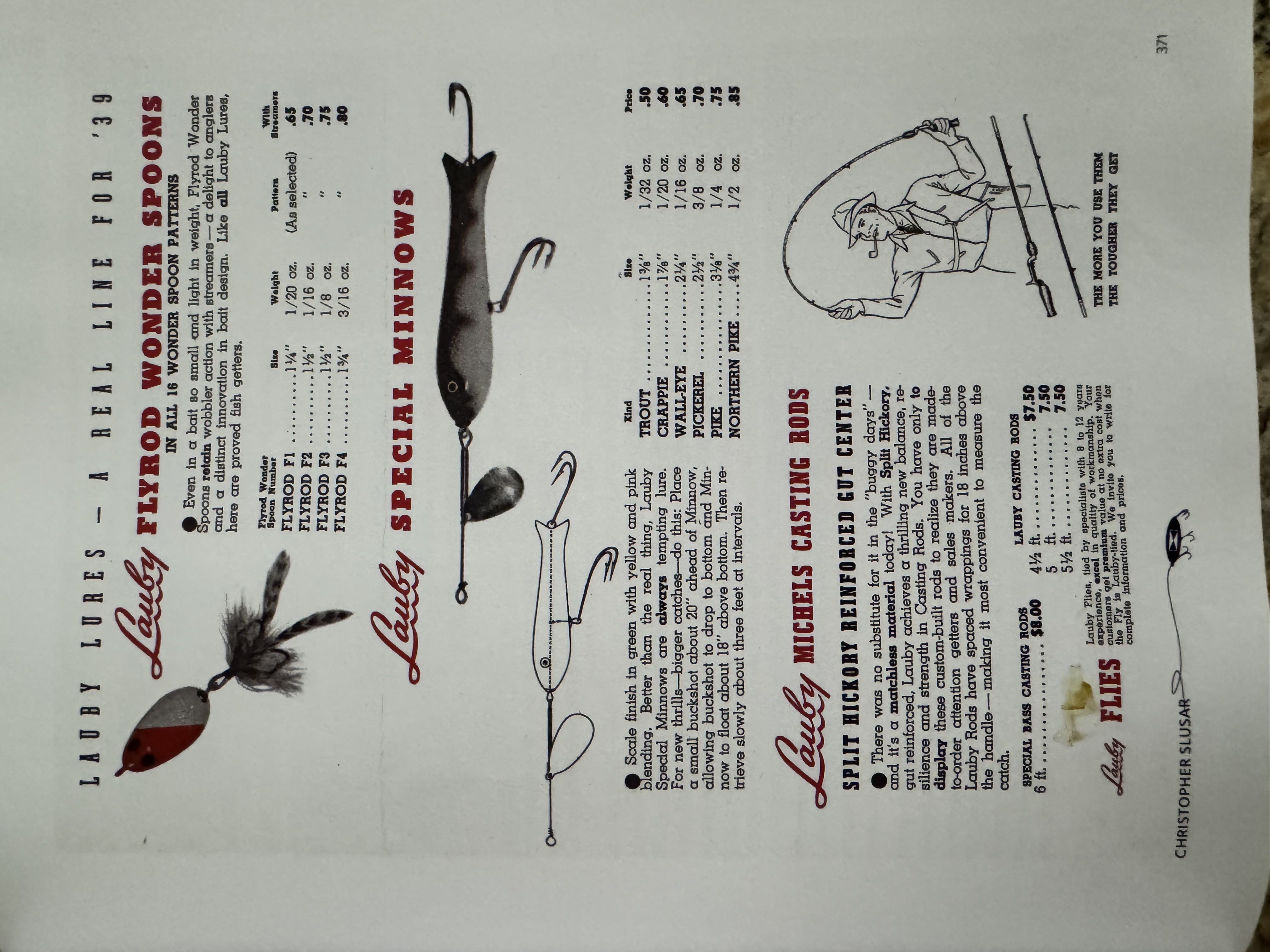
A broader range of baits
The complete 1939 catalog plate for Flyrod Wonder Spoons, Special Minnows, Michels casting rods and flies. Reproduced in Christopher Slusar’s history, p. 371.
Source detailsSelect image to enlarge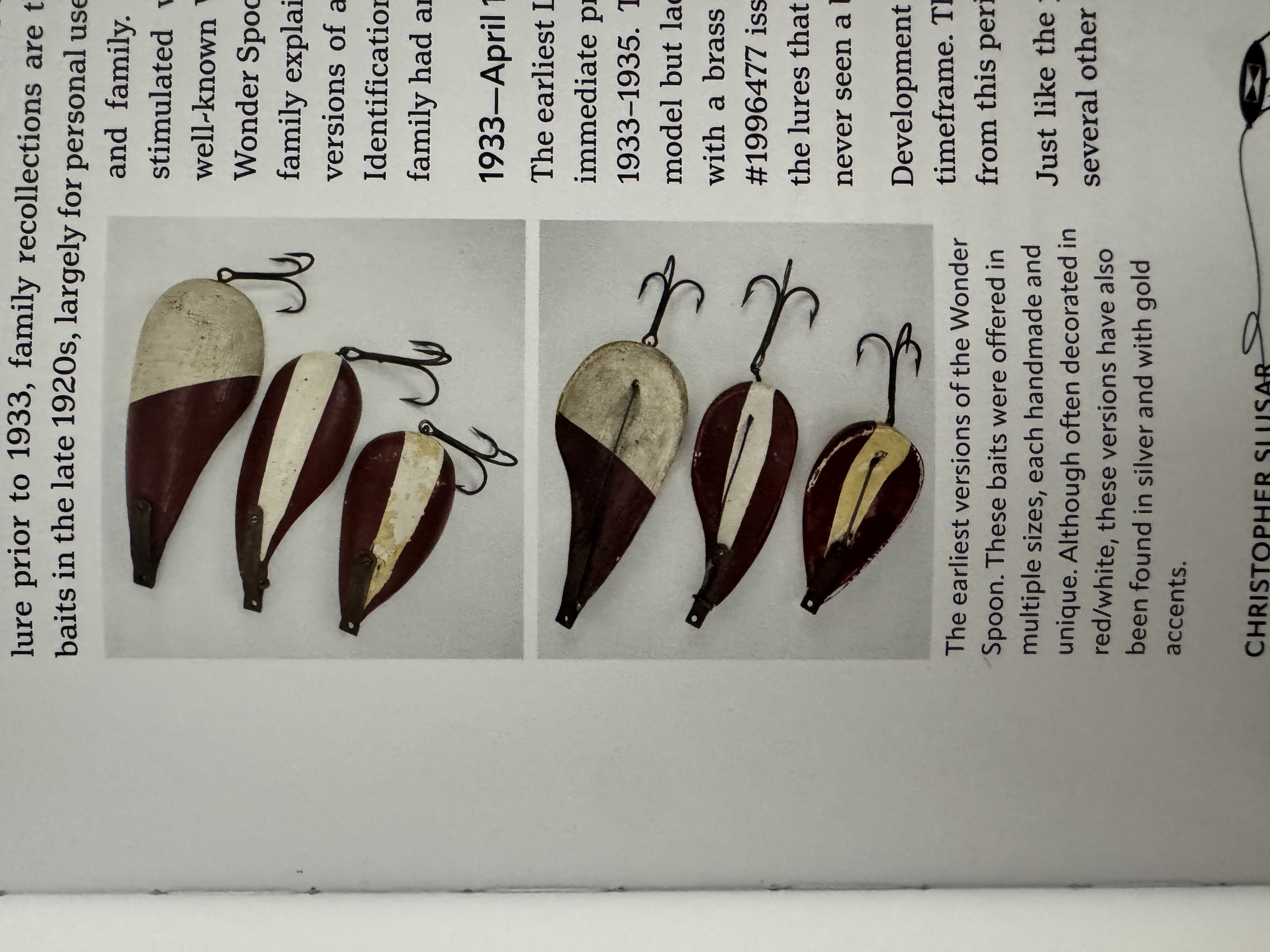
Early spoon forms
Upper and underside photographs of early Wonder Spoons reproduced in Slusar, p. 365. These published examples illustrate the asymmetrical body form discussed in his account.
Source detailsSelect image to enlarge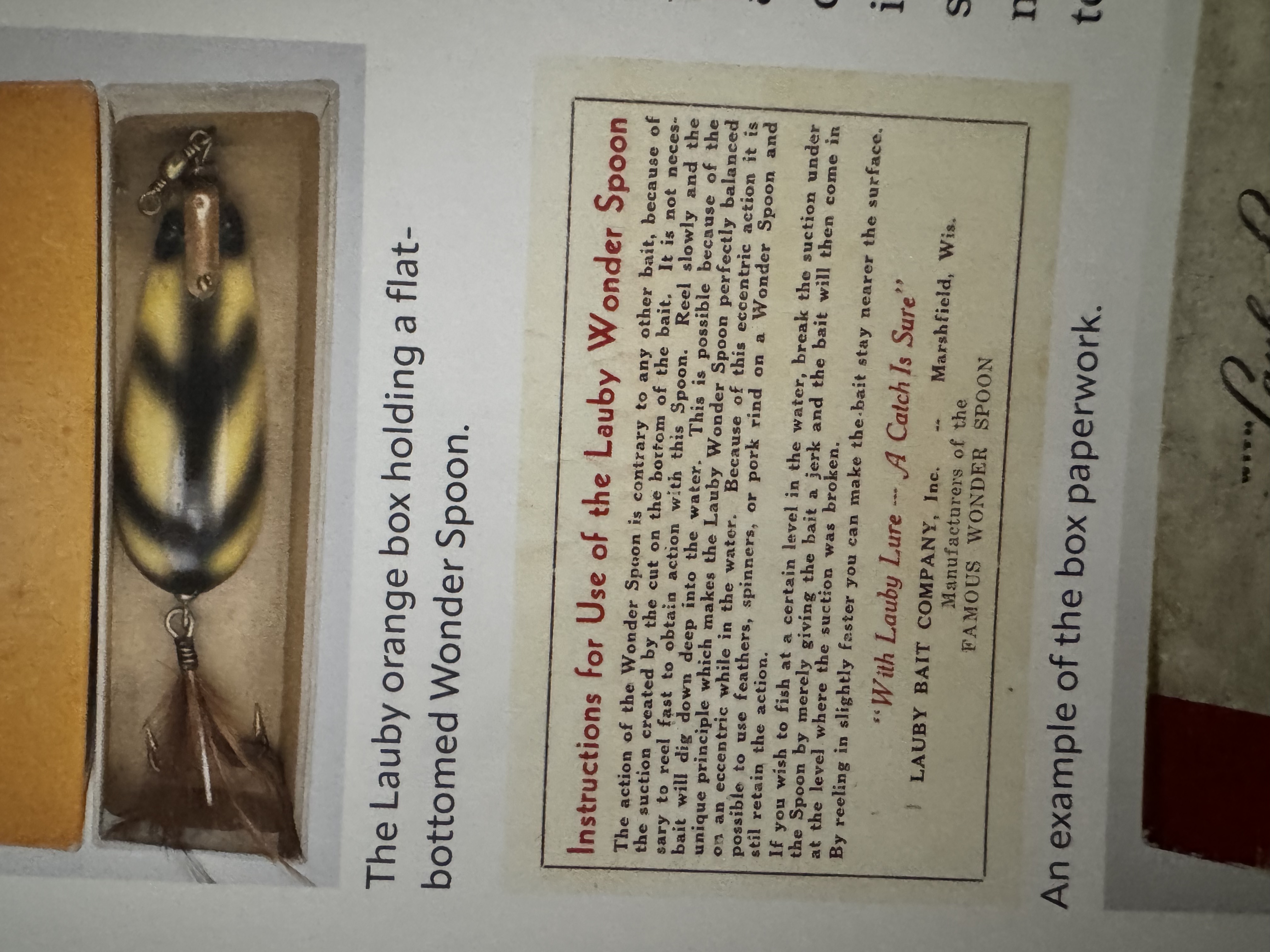
The maker’s instructions
The complete Wonder Spoon instruction sheet reproduced in Slusar, p. 372. The maker explains how retrieve speed affects the lure’s depth.
Source detailsSelect image to enlarge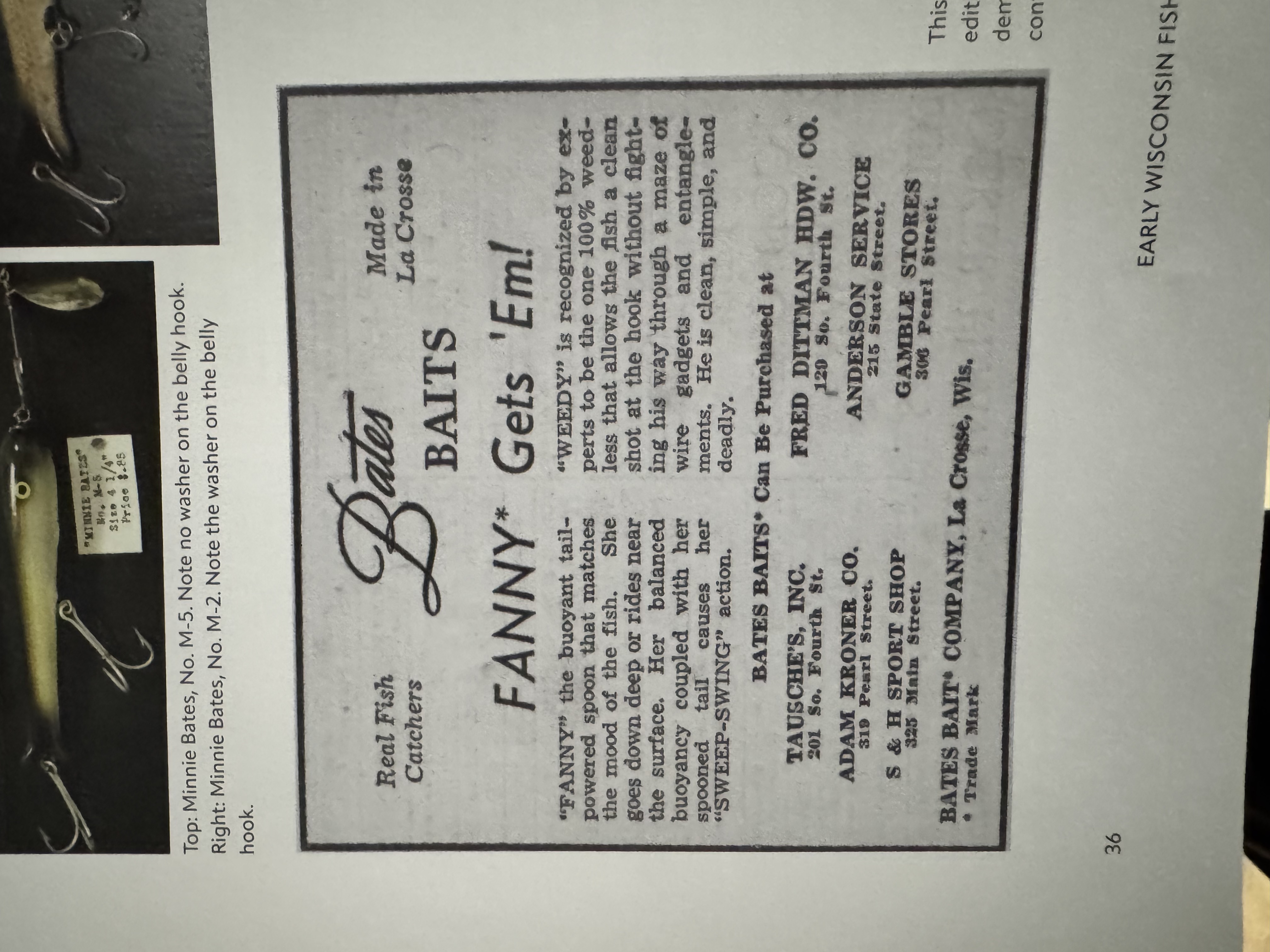
The designs reach a new market
Bates advertising for Fanny and Weedy, identified by Slusar as a La Crosse Tribune advertisement of May 14, 1942. Reproduced on p. 36; see the source notes for the Lauby–Bates manufacturing history.
Source detailsSelect image to enlarge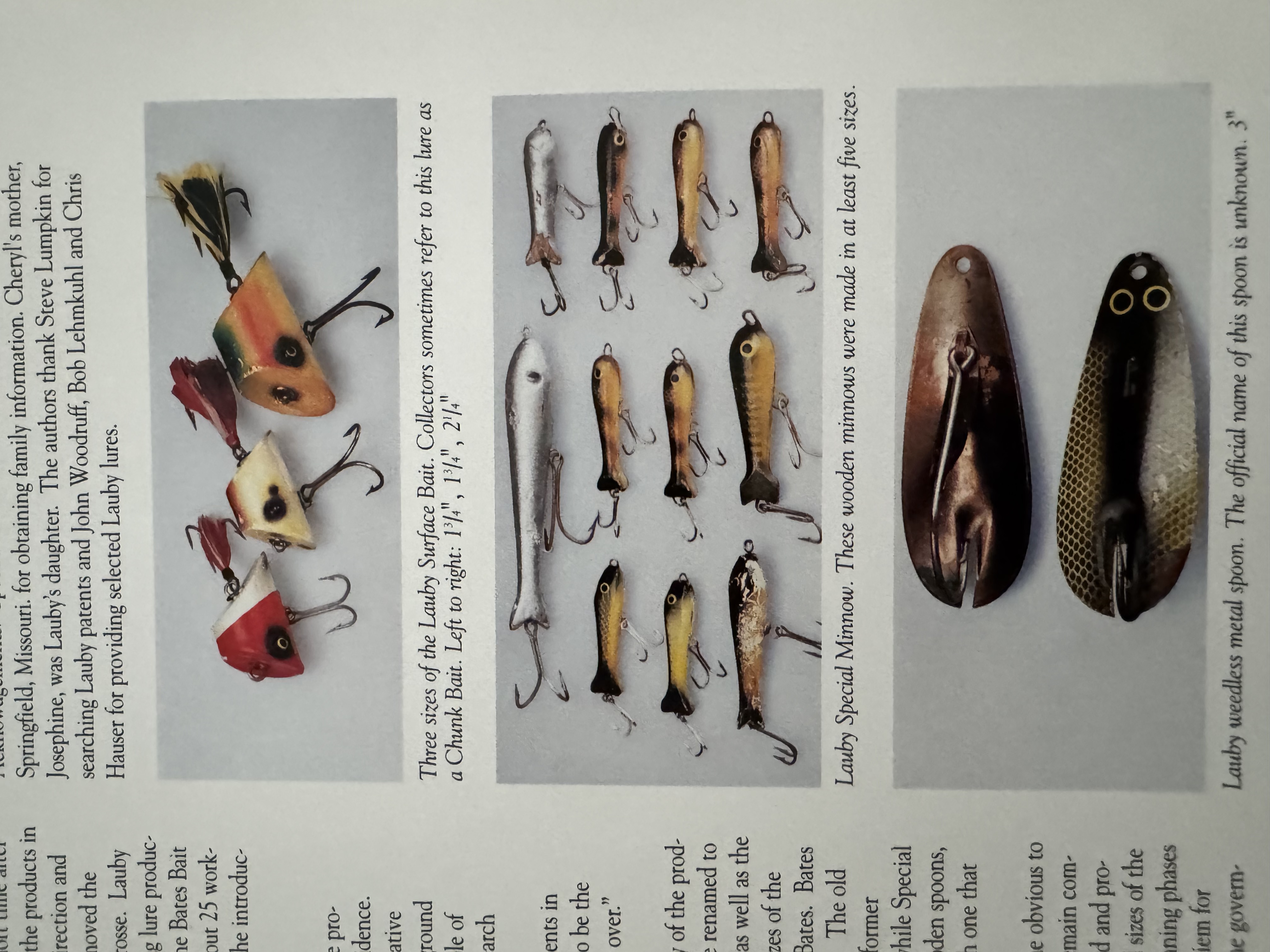
The range in the historical record
Surface Baits, Special Minnows and a weedless metal spoon photographed in Charles and Annette Sanders, “Lauby Bait Company,” NFLCC Magazine, December 1999, p. 27. The metal spoon’s identification with a particular patent remains unestablished.
Source detailsSelect image to enlargePatents and contemporary publications
- Outdoor Life, April 1939, page 82 ↗
A contemporary advertisement for Lauby’s product range. Printed page 82 is PDF page 84.
- Golfdom, March 1938, page 71 ↗
Announcement of the Chicago Sports Equipment Exposition. It documents the event, not a list of Lauby staff or attendees.
- US 1,996,477 · Artificial fish lure ↗
Filed September 15, 1933; granted April 2, 1935.
- US 2,187,475 · Artificial bait ↗
Filed August 27, 1938; granted January 16, 1940.
- US 2,215,908 · Artificial bait ↗
Filed August 27, 1938; granted September 24, 1940.
- US 2,341,926 · Lathe chuck ↗
Filed March 22, 1943; granted February 15, 1944.
- US 2,392,677 · Collapsible artificial bait ↗
Filed May 15, 1944; granted January 8, 1946.
Christopher Slusar’s Wisconsin history
Christopher Slusar. Early Wisconsin Fishing Lures, Hooks, and Harnesses: An Illustrated History of Wisconsin Fishing Lures and Their Makers. “Bates Bait Company,” pp. 32–37; “Lauby Bait Company,” pp. 365–374.
The reviewed excerpts trace design changes, production, packaging, the Bates transition, and later manufacturing. Slusar identifies interviews conducted in October 2004 with TilLee, Roman (Bud), and Roz. He credits Cheryl and Don Wood for helping document the history and supplying the portrait reproduced on p. 365.
The book reproduces period catalog material. Its interview-based narrative is a later historical account; the catalog pages within it are reproductions of contemporary documents.
The 1999 NFLCC article
Charles & Annette Sanders. “Lauby Bait Company.” The National Fishing Lure Collectors Club Magazine, vol. 9, no. 2, December 1999. Reviewed article pages: 24, 26, and 27; issue cover and contents also reviewed.
The article describes Anton’s workshop, specialized tooling, lure designs, and commercial history. It reproduces extracts from the Marshfield News-Herald dated August 3, 1938, and February 25, 1939. Newspaper claims cited here through Sanders have not been checked against independently retrieved copies of those newspaper pages.
The 1938 figure of 500 baits a day is a proposed production target. The 1939 extract reports 49 employees. Neither is used here as proof of total sales or annual output.
The 1939 Lauby catalog
Lauby Bait Company. 1939 catalog selections, reproduced in Slusar, pp. 369–371. Related instructions and packaging appear on p. 372.
The reviewed reproduction shows 16 patterns, six casting sizes of the Wonder Spoon, four fly-rod entries, five Weedless Wonder Spoon entries, three Surface Lures, six Special Minnows, and offerings of casting rods and flies. It provides a reference for period names, advertised dimensions, and the company’s explanation of lure action.
This is a published reproduction of catalog selections, not an inspected original catalog or a complete transcription. Advertised fishing performance remains a manufacturer’s claim. Fine measurements should be checked in the printed table before identifying an object.
How the designs continued
Bates Bait Company. 1941 catalog selections, reproduced in Slusar, pp. 33–35. Historical discussion and illustrations: pp. 32–37.
The catalog associates Lauby’s earlier models with Bates names: casting Wonder Spoons with Fanny Bates, weedless spoons with Weedy Bates, Surface Lures with Topper Bates, Special Minnows with Minnie Bates, and fly-rod spoons with Dinky Bates. The lineage documents the continued commercial life of the designs; it does not make every later Bates variation Anton’s own invention.
Where the accounts differ
- Move to La Crosse. Sanders places the production move in spring 1941; Slusar places it in late 1940. The historical narrative uses circa 1940–41 and keeps the disagreement visible.
- Patents and retail models. The retrospectives associate patent numbers with named products. The 1935 drawing differs from the familiar commercial Wonder Spoon. This archive describes each patent’s mechanism directly and treats exact object-to-patent matches separately.
- The later metal spoon. Slusar associates US 2,392,677 with the later spoon. The patent describes opposed hooks and a spring; a direct match to the pictured single-hook metal lure has not been established.
- Extent of the patent record. The 1999 article describes four patents, ending in 1944. The January 1946 grant extends the reviewed record to five.
- Paint-pattern authorship. Sanders credits Anton with the cataloged schemes; Slusar records TilLee’s account of developing scale and barred patterns. Her specific contribution is attributed to that interview account.
Additional published research
Chris Slusar, “Lauby Bait Company,” Splash, vol. 33, no. 3, Summer 2009, pp. 8–9.
Chris Slusar, “Lauby Family Reunion,” NFLCC Gazette, March 2005, vol. 30, no. 104, is listed in the NFLCC Article Index and referenced in his book. The original article pages have not been reviewed here; the interview material used in this edition comes from the reviewed book excerpts.
Remaining research questions
Original corporate records could resolve the transfer chronology. Individual objects still need measurements, detailed markings, and complete photographic views. The later collapsible-bait patent needs a securely documented production example.
Use the structured collection records and cite the original publication and page when relying on its account. Links and citations do not grant reproduction rights.